

Comments. They are some of the magic sauce of a connected blogging community that knits participants together.
Writing comments is not that difficult to do, but in the rush of all the activity, creativity, connectivity, it sometimes gets lost in the rush. Plus, to give a good comment you need to closely read someone else’s work. Constructive comments are utterly valuable because they are like the gift of conversation. And time.
What is a constructive comment? It should be more than “Nice work” or “I agree”.
It ought to be a few sentences, and include useful feedback or suggestion for improvement. You can explain why you like what was written or agree. Or explain why you disagree. You can offer relevant contexts or links. Or offer additional resources or links that might benefit the writer. For every bit of opinion you might start writing, think of including an “and…” statement.
Use 3 Cs and a Q when teaching students how to comment on others' blog posts. #eci831 #rcsdgenius #rcsdtech pic.twitter.com/BcayxIwT6f
— Danielle Zatylny (@MrsZatylny) November 26, 2014
These comment guidelines for students were created by Dr. Nathaniel Rivers at St. Louis University.
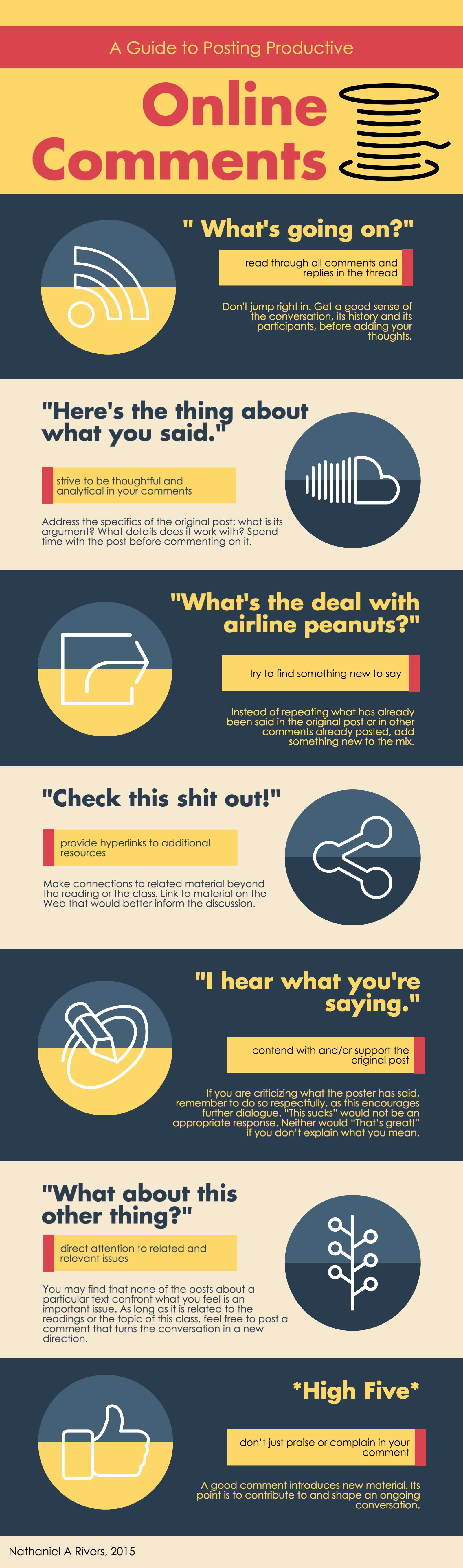
From Dr. Nathaniel Rivers, St. Louis University, found via https://web.hypothes.is/comment-guidelines-for-students/
One suggestion of giving criticism is to put it inside a “sandwich” – open with aspects of the post you praise or agree with, offer critical statements in the middle, and close with a positive. You will find much praise and criticism of the “feedback sandwich”– e.g. done too often, people may take a positive statement as a setup for a harsher negative one.
Maybe the best advice is to comment in the style and mood that you would like to receive. To give something that augments somehow the original piece of writing.

What do you think they are talking about? flickr photo by Sachmanns.dk shared under a Creative Commons (BY-NC-SA) license
When write comments show that you are reading the original work. Respond to specific parts of what the author wrote. As a form of acknowledgement, when someone replies specifically to a point, it means they are listening. Do not be the commenter who just uses it as a means to talk about their own stuff.
For some more advice, see:
- How to be a Good Commenter (John Scalzi, Whatever blog)
- How to Write a Great Comment (Grammar Girl, Quick and Dirty Tips blog)
- How to Criticize Constructively (Wikihow)
- The Ultimate Guide to Leaving Comments On Blogs (problogger)

Propaganda flickr photo by condalezarice shared under a Creative Commons (BY-NC) license
And when you get comments on your site, by all means reply– if it merits a response. Think of this as a conversation; one side conversations are not interesting, right?
For registered students you will not get credit by your teacher counting the number of comments you made – but how you are able to summarize your comment activity and what you gained from visiting other people’s blogs. When summarizing your commenting efforts include
- A summary of what you saw interesting or maybe influential in the blogs you looked at. Did you get ideas you could use by looking at someone else’s post? How did your work compare or differ from theirs?
- A summary of the feedback you got – what was useful? Would it change your thinking? What was helpful?
As new comments come into your blog, you may need to approve them so they will show up on your site. You should be getting emails whenever a new comment is submitted and/or needs approval. Please moderate these comments! The conversation can’t happen if it is never published!
Like many things, you get in proportion to what you give.
Featured Image: an old design 02 flickr photo by hecpara shared under a Creative Commons (BY-NC-ND) license
 Somni Porta

